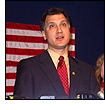
Snapshot
 Martin Sabo is known for his ability to bring life to policy decisions through the budget and appropriations process. He rose in the ranks of Congress to chairman of the powerful House Budget Committee when former chairman Leon Panetta was appointed director of the Office of Management and Budget by President Clinton. But Sabo lost his chairmanship shortly afterward when the Republicans took over the House in the 1994 elections.
His down-to-earth demeanor often masks a brilliant knowledge of legislative and congressional affairs. He helped to bring home a $750,000 grant to beef-up the Minneapolis-area police force and about $1 million in federal funds for a state program to enable senior citizens to receive nursing care in their homes instead of going to expensive nursing homes.
Elected to the state House at the age of 22, he served as speaker there for five years before he was elected to the U.S. House to succeed liberal Rep. Donald Fraser, who ran unsuccessfully for the U.S. Senate.
In 1998, Sabo worked to force corporations to close the gap in pay between their top executives and rank-and-file workers. He sponsored legislation that would tie the corporate tax deduction for executive salaries to the pay of a company's rank-and-file workers.
Sabo, the son of Norwegian immigrants, also helped push through funding for a light rail system for the Minneapolis area in 1998. He also used his position as the ranking Democrat on a House Appropriations subcommittee to get an agreement that Congress would fully fund the $334 million federal share of the Twin Cities' light rail project over the next few years. The agreement was the culmination of years of effort to secure federal money for light rail.
Sabo has supported a woman's right to an abortion and opposed the death penalty. He also serves on the House Standards of Official Conduct Committee.
The liberal Americans for Democratic Action gave Sabo's 2000 voting record a perfect score of 100 points; he got a score of 86 from the American Civil Liberties Union and the American Conservative Union gave him zero points in 2000.
Campaigns
Martin Sabo was first elected to the U.S. House in 1978, defeating Republican Michael Till with 62 percent of the vote. He was re-elected to seven consecutive terms by wide margins, defeating Republican Raymond C. Gilbertson in 1990 with 73 percent of the vote and in 1992, he defeated Republican Stephen Moriarty with 69 percent of the vote. He was re-elected in 1994 with 62 percent, defeating Republican Dorothy LeGrand. In 1996, he was re-elected with 64 percent of the vote against Republican Jack Uldrich. In 1998, Sabo defeated Republican Frank Taylor with 67 percent of the vote and again in 2000 with 69 percent. Taylor was a longtime teacher in Minneapolis public schools and the Republican Party's endorsed candidate. His top issues are education, crime and taxes.
Sabo served nine terms in the state House before his election to Congress. He generally skips high-profile television campaigns in favor of face-to-face contact with constituents _ door knocking and handing out literature at bus stops and shopping centers.










 © 2026 | Home : Terms of Use : Your Privacy Rights