



In the Spotlight

Tools
News & Features
Waterbee Toy Company (B)
The Risk of Knowledge

Copyright © 1998 by the University of St. Thomas, Minneapolis-St. Paul, Minnesota.


Should Monitoring Occur? | The Risk of Knowledge | Note on Privacy in the Workplace

Leila Muhammed put the file down and shook her head. The first EcoScope report from the Internet tracking had just come up from security, and the results were not good. Over the first week, all but one of the employees had spent time on the Internet; over 70,000 sites had been hit, many of them of an adult nature.

It had been just one week since Leila had supported Security' s recommendation to monitor employee use of the Internet. After seeing the first report, Security wanted to step back and pretend they had never even started monitoring.

Leila looked at the security report again. One particular entry was highlighted. One computer had logged eight consecutive hours at a single pornographic site. Leila pulled up the employee' s file. He was an individual contributor who performed at a consistently satisfactory level. Was this even an issue? After all, he was an adult and he was getting his job done. Leila looked at the note that Security had attached. The individual who was assigned that computer had spent those eight hours in the building. The employee did not have his own private office; he worked in a cubicle. Leila glanced at Waterbee' s policy on sexual harassment (see Exhibit 1) and then made a phone call to Waterbee' s legal department. The call confirmed that the pornography displayed on the computer monitor could be seen as creating a hostile working environment in the same manner as centerfolds tacked to a cubicle wall would.

Leila considered Security' s recommendation to delete EcoScope (Exhibit 2) and stop monitoring. After all, Security had rationalized, following up on all of these hits was unrealistic. They would have to confirm that the individual assigned the computer was in the building at the time. While this could have been done through the entry and exit log, they would also have had to confirm that the individual was at his or her computer when the site was hit, which was virtually impossible. Finally, they would have to check whether the individual had an office (rather than a cubicle), and was therefore not creating a hostile working environment. These three variables made it almost impossible to prove whether or not an employee created a potentially hostile environment.

The question regarding what to do, not only with the employee in question but with the monitoring issue, weighed heavily on Leila' s mind.

Exhibit 1 - Waterbee Toy Company (B): Excerpts from Waterbee Toy's Sexual Harassment Policy
A MATTER OF RESPECT
1. INTRODUCTION AND COMPANY POSITION

Waterbee' s policy regarding sexual harassment is very clear: the Company will not tolerate unwelcome sexual advances and conduct that interferes with an individual' s work performance.

Waterbee will take prompt and appropriate action to investigate and resolve any alleged or suspected incidents of sexual harassment. Appropriate corrective and/or disciplinary action, including the possibility of dismissal, will be taken in all confirmed cases.


3. WHAT IS SEXUAL HARASSMENT Sexual harassment is a form of discrimination and is, therefore, illegal. The Guidelines issued by the Equal Employment Opportunity Commission under Title VII of the Civil Rights Act of 1964 state that unwelcome sexual advances, requests for sexual favors, and other verbal or physical conduct of a sexual nature constitute harassment when:
a) submission to such conduct is made explicitly or implicitly a condition of an individual' s employment and or advancement, or
b) submission to or rejection of such conduct by an individual is used as the basis for employment decisions affecting such individual, or
c) such unreasonable conduct interferes with an individual' s work performance or creates an intimidating, hostile, or offensive working environment


CLOSING STATEMENT

Waterbee is committed to an environment that values diversity thereby recognizing the rights and individual differences within each organization. It is an individual' s right not to be subjected to sexually harassing behaviors in the work-place and, as stated previously, Waterbee will not tolerate such behavior. Not only is it a barrier to contribution that lowers production, but it also shows a lack of respect.

Respect is one of the most basic building blocks of any productive organization. Respect for one another as colleagues, as competent contributors, as subordinates, or as bosses is fundamental to getting work done in a way that allows everyone to give their best. Lack of respect for someone gives the message that, "You are not worthwhile. What you have to say or what you think doesn' t matter."

Our workforce is becoming more diverse and that trend will continue in the future. We are adopting cultural norms and rules of workplace conduct to conform to that diversity. By using respect as a guidepost for conduct we should be able to grow and maintain working relationships that are both humane and productive. Most importantly, respectful relationships allow all members of the team to feel included and to give their confident best.


Exhibit 2 - Waterbee Toy Company (B): EcoScope Material on Employee Internet Use

DETECTING NETWORK ABUSE
One of the most invasive applications that has emerged in both business and home computing is the World Wide Web. There is a staggering amount of information in the Web which can be useful to a business - equally, there is an awful lot of data available on the web that has no strategic value to business.

Therefore, providing access to this facility can be open to abuse. For example, staff members "surfing" the web rather than working during the business day. As such, assessing the WWW application traffic flow often makes an interesting case study.

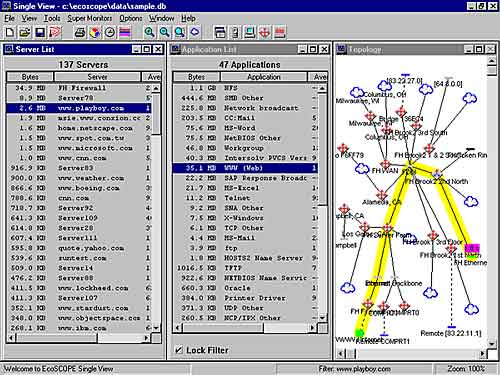
By locking the Application Filter on World Wide Web (shown in the diagram below), we are able to see all the Web Servers that have been accessed. Clearly the one web site that does not benefit most businesses is - "www.playboy.com".


Using EcoSCOPE, we are further able to determine which station accessed this server, as well as what other servers this station has "surfed" and by identifying the exact address of this station, we can implement business policies to ensure users refrain from accessing undesirable sites.


This case was prepared by Research Assistant Hassan Valji under the supervision of Kenneth E. Goodpaster, Koch Professor of Business Ethics, University of St. Thomas, to accompany the Waterbee Toy Company Case series. Copyright © 1998 by the University of St. Thomas, Minneapolis-St. Paul, Minnesota.