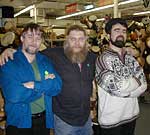
A trio of Karelian folk musicians is in Minnesota to sing and play centuries-old music from their homeland. Karelia is a piece of northern Europe between Finland and Russia. The land is carpeted with forests and dotted with lakes. These days Karelia is an autonomous region of the Russian Federation. The Karelian Folk Ensemble tunes showcase ancient instruments and stories of forest wizards.
Arto Rinne, Igor Arkhipoff, and Alexandser Bykadoroff perform performs on March 8, 2001 at the Cedar Cultural Center in Minneapolis and March 10, 2001 in New York Mills.
THE VIOLIN AND GUITAR ROOM at the Groth Music store in Bloomington is the temporary staging area for a brief Karelian Folk Ensemble performance. The trio is at the store to pick up a rental bass, and they have agreed to play a couple of tunes for a gaggle of curious onlookers. The instruments they unpack - carved flutes wrapped in birch bark, a cow and a ram's horn with finger holes - resemble antiquities from a music museum.
"This is the most terrible sound instrument, the goat horn," admits Igor Arkhipoff as he belts out a version of Tchaikovsky's Swan Lake; seldom, if ever, played on ram's horn.
Arto Rinne picks up a carved piece of maple wrapped in birch bark.
"This is a shepherd's flute; you can play more difficult melodies," Rinne says.
The instruments create an eerie and soulful introduction for a Karelian dance called Persuasion, which sounds like woodland spirits coaxing the sun to rise and then dancing in the warmth of the morning rays.
Karelia is larger than Iowa, smaller than Minnesota. The sparsely populated region is the source of the Kalevala, a collection of myths and legends about forest dwelling spirits with human qualities. Karelians are a minority population. Russian-speaking people dominate.
Arto is Finnish, close cousins of the Karelians. Igor and Alexandser Bykadoroff are Russian-speaking Karelians. They collect and perform tunes from all groups in the region like a Russian wedding song.
Weddings and other festive gatherings keep some of the old songs alive. But Arto says the really old tunes - epics, chants and spells - ones that don't easily fit into a dance hall play list - those are disappearing.
"People like younger people don't know these songs anymore, so only very old people can sing those stories," Arto says.
Bells are another set of instruments in the Karelian Folk Ensemble's bag of musical surprises. The required church bells are a little cumbersome for an international tour so the trio brought along some miniatures.
Karelia's religious tradition is Eastern Orthodox Christianity. Arto says the church bell influence has found its way into the region's popular songs.
"People who used to live close to big monasteries, they could hear music of church bells and started to imitate church bells in kanteles."
The Karelian Folk Ensemble is winding up their North American tour in Minneapolis and in the central Minnesota community of New York Mills, a stronghold of Finnish-American culture where they are likely to be met by people who will sing and dance along on some of the tunes.










 © 2026 | Home : Terms of Use : Your Privacy Rights