The economic slowdown is taking a toll on Minnesota's job market. Unemployment remains low, but layoffs and jobless claims are soaring and job growth has shrunk by half. The spate of job cuts is also raising concerns about Gov. Jesse Ventura's goal of cutting state funding for a program to help laid-off workers.
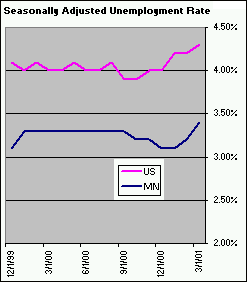
Unemployment is edging up, but it still remains relatively low.
TWO WORDS HAVE DOMINATED the employment market in Minnesota for years: worker shortage. No longer. Employers have cut nearly 19,000 jobs in Minnesota since last July, and that's counting only mass layoffs. State officials say total job losses are much larger than that.
At the same time, Jay Mousa with the Minnesota Department of Economic Security says compared to recent years, the average annual job growth has slowed by half or more.
"Laid-off employees will not find jobs as easily as they did before. So, the number of initial unemployment insurance claims will go up, and we expect the unemployment rate to go up also," he says.
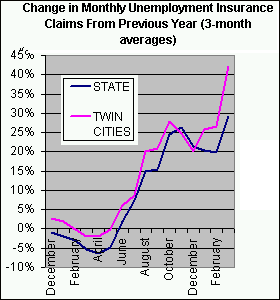
First-quarter unemployment claims in Minnesota jumped nearly 30 percent compared to the same period last year. Last month, Twin Cities' jobless claims spiked by more than half compared to March 2000.
Todd Graham, a Department of Economic Security analyst specializing in the Twin Cities, says the Twin Cities' economy is more subject to the broader economic slowdown.
"The Fortune 500 companies and the major manufacturers that are located in the Twin Cities, tend to be more tied into regional, national and global markets. They'll feel those effects more acutely than the Main Street economies of Willmar or Worthington," Graham says.
Still, Graham says this isn't a bad time to find a job. A state survey found job openings more abundant than the unemployed at the end of last year.
Nonetheless, Liz Kniffen a job counselor working with the state dislocated worker program in Minneapolis, says her clients seem more discouraged.
"Even a year ago when people would receive a rejection, they would continue on. But now, when people receive a rejection, the tendency is to think, 'There were probably 200 people who applied for that job. How am I ever going to find work?'" Kniffen says.
The trends are provoking alarm about Gov. Jesse Ventura's plan to eliminate $21 million in annual state funding for the dislocated worker program. A smaller amount of federal funding would remain. The program serves some 14,000 laid-off workers with job counselling and financial assistance for retraining.
Demand for jobless benefits soars
"I anticipate that the doors of dislocated worker programs will be shut to new dislocated workers on July 1st, if the money is not available," says Diane Tessari, who coordinates the dislocated worker program in Minneapolis. "The need is critical because of the high level of need for dislocated worker services, the increasing number of events that we're experiencing, the increasing numbers of people."
The program reports a job placement rate of 84 percent, at wages close to those before the layoff. Pat Millard received training as a specialized massage therapist and saw her income jump dramatically after years of trying to support four kids on $10- and $12-an-hour jobs. She says the state's investment will pay off.
"The amount of money that was put toward my education is really just a fraction of what I probably would have been using of state money over the years, between food stamps, medical assistance, child care assistance, energy assistance," she says.
Ventura administration spokesman John Wodele says the governor's goal is to direct funding to individuals not programs. "You are better off having financial aid, and educational opportunities that people can customize, can pick and choose from, rather than creating a separate entity or a separate government program for every group of people," according to Wodele.
At this point, neither the Minnesota House nor Senate appears to be going along with the governor's plan to end funding for the dislocated worker program, though the House proposal would cut some $9 million a year.










 © 2026 | Home : Terms of Use : Your Privacy Rights