



A decade before their attack on Pearl Harbor, the Japanese had invaded and occupied broad stretches of China and the Korean peninsula. Japan's aggression included the massacre of more than 300,000 people in one of China's major cities, Nanjing. On May 30, 2001, Asian and American composers and musicians - including cellist Yo Yo Ma - presented the first concert of remembrance and reconciliation.
A CONVERSATION WITH YO YO MA
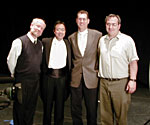
Yo Yo Ma (second from left) flanked by MPR's Dan Olson (left), Silvester Vicic and Michael Demark. Listen to Dan Olson's conversation.
CHINESE AMERICAN COMPOSER CHEN YI remembers her mother's nightmares. Chen says her parents never forgot the experience of running from city to city, trying to escape the Japanese bombs.
"My mom always woke up with nightmare, shouting very loudly and shaking and say that, 'run away, quickly, the plane is chasing us like this,'" she recalls.
Chen Yi is a professor of music at the University of Missouri, Kansas City and makes her home in Boston. A string trio including the pipa-a traditional Chinese instrument like a lute, are part of her composition, titled Ning, an abbreviation for Nanjing. It's named for the city where the Japanese massacred hundreds of thousands.
Korean American composer Hi Kyung Kim is a professor of music at the University of California Santa Cruz. Her work, At the Edge of the Ocean, includes passages of a Korean folk song. Her grandparents were part of Korea's underground resistance to Japan's occupation in the 1930s. Japanese police arrested Kim's grandparents and their relatives for hiding an underground movement leader.
"I just learned recently that my mother said they were hanged, and they were beaten. And several of them got gunshot wounds," Hi Kyung Kim says.
The accounts of Chen Yi's parents and Hi Kyung Kim's grandparents - and thousands more like them - are the basis for the St. Paul concert called Hún Qiáo, or Bridge of Souls.
"Music and words could be weapons to encourage to go to war sometimes. We, as musicians and poets, should refuse our music and our poem used as a weapon."
- Michio Mamiya
Asian Americans started organizing the event after a Minnesota Orchestra concert in 1995. They stood in silent protest near Orchestra Hall in Minneapolis as musicians presented a piece by a Japanese composer to honor victims of the bombing of Hiroshima. The protestors said Japan's treatment of Chinese and Koreans was being overlooked.
St. Paul businessman Weiming Lu, a founder of Minnesota's Chinese American Association, and one of the organizers of the concert, says the theme comes from a cultural tradition in China, Korea and Japan to help souls find their way home.
"We would call the soul to come back, so to speak, so they can rest at home, no longer wandering around the world. We think this is needed to be done; many of these people were wounded deeply during the war. It's needed to heal the wounds and call the soul back," he says.
A handful of Japanese say descriptions of their aggression are exaggerated. But Japanese composer Michio Mamiya says it's his solemn duty to participate in the concert of remembrance and reconciliation because of his country's behavior. Mamiya says he wants his composition which includes soprano Mutsumi Hatano to be a magical power to heal our mind.
"Music and words could be weapons to encourage to go to war sometimes. We, as musicians and poets, should refuse our music and our poem used as a weapon."
The Bridge of Souls the concert at the Ordway Center in St. Paul included cellist Yo Yo Ma and pipa player Wu Man. Organizers say they've asked to stage similar concerts of remembrance and reconciliation in other cities.