





 |
|
 | Real Audio |
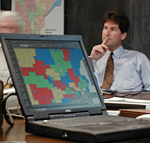
It's sometimes hard for the public to follow the complicated process of redistricting, but it poses important questions for communities around Minnesota. In few places are the issues as clear as they are in St. Cloud.
 | | |
| ||
 | ||
One road leads southeast into billboards and big-box retail -- but also to the culture and energy of the Twin Cities.
The others lead west and north, toward lakes, corn fields and dairy farms -- and small towns that see St. Cloud as a metro area in its own right. A decade of spectacular growth along Highway 94 has given rise to an identity crisis that the redistricting process now lays bare. The governor's plan, for example, would put St. Cloud at the northern end of a congressional district that includes much of the northern metro area. The Republican legislative plan would link St. Cloud in a single senate district with cities as far south as Monticello, while DFL plans continue to link St. Cloud more closely with rural areas.
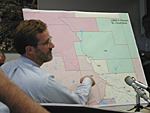
Two city council members, who have since become the leading candidates for mayor, came down on different sides of the issue when a legislative working group visited St. Cloud to get public input on the plans. Council president John Ellenbecker says socially and economically, St. Cloud is still tied to rural Minnesota.
"In terms of this orientation and how we see ourselves, I think we see ourselves more as a trade area," Ellenbecker said. "This trade area is toward Willmar, Alexandria, Brainerd and Milaca as opposed to down that Highway 10 corridor. I'm not sure if that helps or hurts the process, but I'm not sure that we we see ourselves as having as much in common with the northern metro."
| | |
| ||
| ||
But Councilman Mike Landy, a member of the Independence party, says the governor's plan reflects the new reality.
"We discussed the regional park issues, we were discussing transportation, we have so much more in common with these areas that are growing and urbanizing than areas that are agricultural in nature and such," Landy said. "And when we're fighting for transportation dollars the way we are, and when we're fighting for all the things that we need to grow, I think we need to look to the people who have experience delivering that."
There's some merit to that argument, says Bob Weber, a political science professor at nearby St. John's University. Legislative staff for such a district could afford to specialize in urban growth. Transportation issues will become more important as the proposed Northstar commuter rail line creates a new link to the metro.
But Weber thinks St. Cloud may be more independent-minded than that.
"St cloud residents at one time kind of regarded themselves as kind of an island unto themselves out here in the rural area," he said. "Kind of a moderately sized city, a trade center, rather than as some part of a suburban stretch that runs from Minneapolis up to St. Cloud. They may not have a lot in common with people from Anoka or someplace like that."
DFL Rep. Leslie Schumacher, whose mostly rural district covers a corner of St. Cloud, worries about the urge to separate rural and urban areas at both the legislative and congressional levels. She says legislators and constituents benefit from districts with diverse perspectives, and calls this desire for specialized representation "unhealthy."
"Making sure that we have that high quality of life extending from metropolitan areas to rural communities is critical," she said, "and I don't think that it will happen if we define the lines for legislators harshly between a metropolitan area and a rural community. It creates more divisiveness and more head butting, and the rural communities are losing out, big-time."
Local officials are split on the best course to take, but agree the arcane process of redistricting can nonetheless change the community's identity. The wild card is whether St. Cloud citizens will speak up to indicate where their allegiances lie. So far the signs are not good; even before this month's events, Schumacher guesses fewer than a quarter of voters were paying attention.
The redistricting plans
(The maps are pd files, which require Adobe Acrobat Reader)
 © 2026 | Home : Terms of Use : Your Privacy Rights