





 |
|

Soccer's World Cup is happening all this month in Korea and Japan. But you don't need to fly to Asia, or even make a date with ESPN at 2 in the morning, to find international soccer action this summer. Immigrants who've come to Minnesota have brought their favorite game along with them.
 |
|
|
|
||
|
||
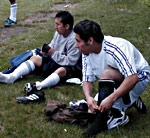
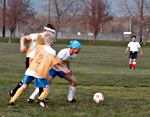
Just another Saturday afternoon in St. Cloud. "White Cloud," it has sometimes been called in the past, largely because of the German, Catholic dominance here. Anyway, on this particular Saturday afternoon in St. Cloud, the Arabs are driving upfield toward the Laotians. The Arabs showed up short-sided, so some Somalis are filling in. The Laotians would normally play the Vietnamese on a Saturday, but the Vietnamese had a game in Fargo this weekend.
"White Cloud" indeed.
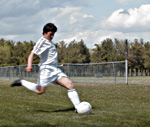
Immigrant communities in St. Cloud and many parts of Minnesota are reaching the certain critical mass it takes to field a soccer team. Ethnic-based teams in the Minnesota Youth Soccer Association have gone from zero five years ago to more than two dozen today. And there are dozens more unrecognized youth and adult squads playing every night in the Twin Cities and smaller cities like St. Cloud, Rochester and Mankato.
| |
|
|
|
||
|
||
Rural communities like Melrose, in central Minnesota, are also seeing their share of action. On a recent weekend, Spanish shouted from the sidelines can be heard down the length of the field as coaches for the Melrose Real Madrid try to coax in a goal before the team heads into halftime, down two-nil. They're part of a seven-team league, almost all Mexican, that plays a set three-game schedule in Melrose every weekend.
The league is two years old, and still without a name. There's a referee on the field, and the teams play in shiny new uniforms. Thirty-one-year-old Luis Gomez is lacing up his shoes to head in. He works weekdays in a St. Cloud diner, but plays for the Melrose team.
"(There are) four teams in Long Prairie, one in Melrose, one in St. Cloud, one in Avon," Gomez says. "This is the game for all Mexican people, the soccer."
| |
|
|
|
||
|
||
Like Real Madrid, their opponents, the Long Prairie Pumas, named themselves after a professional soccer team. Mustachioed coach Armando Brabo works his day job at a Long Prairie egg plant.
"This uniform we have right now is from Mexico," Brabo explains. "It's a professional team in Mexico, the Pumas. Last year we had the uniform of Long Prairie Packing. They supplied the uniform (and) helped us out."
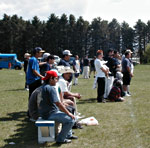
The Pumas' side of the field has room for the crowd, and a couple dozen spectators have come out to watch. In the parking lot an old, blue school bus has its emergency door swung open and an entrepreneurial family is selling candy, corn on the cob and frijoles out of the back. Across the asphalt, tough-looking teenagers crowd around their cars and compete with their stereos.
| |
|
|
|
||
|
||
Brabo says the regularly scheduled games become an excuse for a community event. He says most of the people who come to the games also work together.
"Some people work in Jennie-O, some people work in Long Prairie Packing...(Players) invite 'em, you know. 'Hey, come see us play!'"
Back down the road in St. Cloud, Larry Haws is a Stearns County commissioner also known in some circles as "Mr. Soccer." Over decades of coaching, Haws has run into players from cultures around the world. The Japanese? Fairly peaceful ball-players. Mexicans are more aggressive, he thinks, because they follow pro soccer so closely.
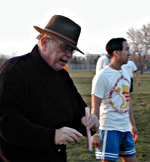
On this night his competitive team of 16-year-olds is scrimmaging with part of St. Cloud's Vietnamese team. Haws says it's good experience in more than one way.
| |
|
|
|
||
|
||
"It makes the world a lot smaller," Haws says. "Right now the world for this is 120 yards long by 75 yards wide."
Haws enjoys the different styles of play different cultures bring to the game.
"Makes a lot of difference whether they're coming from a country that has grass, or a country that has sand, or wet soil conditions," he says. "How they pass the ball, at what level in the air do they pass the ball, it makes a difference. Also the size of the fields. This size of field, in many countries, if they had it open they would put it in crops. They wouldn't use it for athletic turf."
Haws's team has Nick Hanks in the goal. Hanks says he sees some of these guys around school now and then, but this is the only time many white and Vietnamese players interact. He says playing the Asian teams is great practice.
| |
|
|
|
||
|
||
"They play more controlled," Hanks says. "They pass the ball better than a lot of Minnesota (players). They know the game well, is what I'm trying to say."
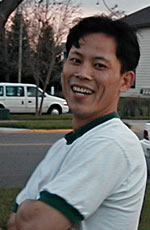
As a teenager, Tri Nguyen escaped Vietnam in 1986. After detours through the Philippines and Wisconsin he's found a role in St. Cloud as a community organizer and sometime soccer player.
"This is the first step," Nguyen says. "I try to get the kids I know together, and then they can go out and get their peers and then bring them in and form the team."
As Nguyen sees it, the soccer team will do more than just play soccer. They also perform around the region as the Vietnamese dragon dance squad. And they're a ready-made corps of young men to pitch in on various community projects.
|
"If we can use something as simple as the game of soccer to bring people together and give them a sense of community, that's something we can all support."
- Ellie Singer | |
"We can hang out, we can come out and do a lot of stuff. The main focus is to keep the kids off the street, and to keep the kids in a group where they can make commitments and keep toward their goal of staying together."
Even though the dominant image of U.S. soccer today might be suburban kids piling out of a minivan, the president of the Minnesota Youth Soccer Association says soccer began in Minnesota as an immigrants' game. Ellie Singer, a self-described "soccer mom," says immigrant communities from Europe first brought the game to the Twin Cities midway through the last century.
Singer says the MYSA has a relatively new program called "Soccer Start" to get more ethnic teams and people of color involved with the organization. They've brought Laotian, Hmong, Somali, and Hispanic teams on-board, mostly in the Twin Cities. The MYSA can provide referees, secondary insurance, and a regular chance to play. But Singer says finding a field to use every week and going through the paperwork can be a turn-off for some of the teams out there.
| |
|
|
|
||
|
||
"Between those two things and the fact that a lot of these kids have a lot of challenges for getting them to a soccer game, it can be overwhelming for a coach," Singer says. "It may be easier just to do a pickup thing than to commit yourself to a weekly league game where you have to have kids there."
There is one largely Hispanic girls' team in Minneapolis. Singer says getting girls involved has also been a tough nut to crack.
"Especially for those cultures where the woman has not been an athlete and has been known to take care of the home rather than (join in) sporting events, which are predominately male," she says.
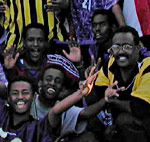
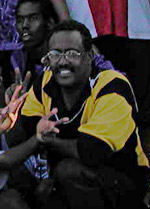
Even if only men are on the field, Somalis in St. Cloud see their team as a major step in the evolution of the whole community. Somalis say their population in the city has grown from 45 to nearly 2,000 in the past two years. They were celebrating their emergence as a community when the team hosted its first game this month against a Somali team from Marshall.
The game was a three-three tie, but community leader and referee Mohamoud Mohamed grabs the mic to celebrate a victory.
| |
|
|
|
||
|
||
"We are happy and we are making here our home and our youth are doing good," Mohamed says. "And again I would like to say, 'Thank you very much Marshall. You did a good move, you visited us, welcome to St. Cloud, and we will visit you too!'"
HealthPartners will help provide uniforms in the fall, and there are former Somali soccer pros among the St. Cloud community who should give the team a boost of talent. Mohamed wants to win, but to him the crowd gathered around tells him this is sports in the service of a deeper ideal.
"You can see the number of people here today without even advertising that much," Mohamed says. "They just came out to watch the game. It is very interesting, and it is of the first times we socialize like this since we had that civil war in our country. The people in St. Cloud, it is the first time to have this coming together."
For Mohamed and many other immigrants it may be no great exaggeration to say soccer really is 'more than a game.'
More from MPR © 2026 | Home : Terms of Use : Your Privacy Rights