





 |
|
Most of us think of earthworms as benign creatures. Gardeners are always happy to spot a worm in the flowerbeds. And many anglers say they're the best way to catch fish. But scientists are beginning to learn worms aren't so friendly to forests.
 |
|
|
|
||
|
||
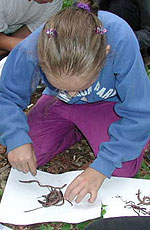
At Hartley Nature Center in Duluth, a Girl Scout troop is learning about worms. Naturalist Judy Gibbs shows the girls how to coax worms out of the soil by pouring water laced with powdered mustard into the worms' burrows.
It irritates the worms and they come squiggling up by the hundreds.
The girls squeal with delight.
On their walk through the woods, the girls look for dead leaves. There aren't many. Judy Gibbs explains why.
She shows the girls a leaf stem that's being pulled into a tiny round hole in the ground.
"Who's doing this?" she asks. The girls guess, "Ants! Salamanders! Worms!"
Gibbs explains that night crawlers dig burrows in the ground. "They come up at night and pull leaves straight down into their burrows. And they eat the leaves right off. That's why we can't find any leaves."
Exotic creatures
Worms eating leaves may seem natural, but it turns out these worms aren't native to these woods.
The last glacier buried Minnesota. When it melted, plants and animals returned to create a community of maples, pines, songbirds, trillium and other tender plants growing on the forest floor, but not earthworms.
| |
|
|
|
||
|
||
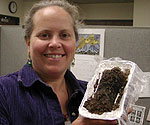
Cindy Hale is a biologist who studies the native wildflowers that grow in northern hardwood forests. She loves the spring bloomers that take root in the spongy layer of decaying leaves on the forest floor: trillium, bloodroot, solomon's seal. Hale says many of these plants are disappearing.
"Sites that forty years ago were carpets of trillium have been slowly, over the last two decades, declining to almost nothing," she says. "People were scratching their heads, trying to figure out what's going on."
Earthworm populations are thickest close to cities. But Hale says people bring worms with them when they come to the northwoods.
| |
|
|
|
||
|
||
At first, settlers carried them in, along with the animals and plants they brought from Europe or the east coast. These days, worms hitchhike with people who drive in the woods - loggers and ATV riders. But anglers are the biggest worm-carriers.
Fishing bait is a huge way that worms get moved around in our region," Hale says. "Because there's so many lakes and so much fishing."
Research
Hale and her colleagues set up test plots along an advancing line of worms in the Chippewa National Forest. The worms crawl about three yards further into the forest each year. Hale is studying how the soil and the plants have changed as the worms advance.
Worms eat the decaying leaves on the forest floor. They mix that organic matter into the mineral soil beneath it. And in time, they can use up all the organic matter and leave only mineral soil behind.
The plants that have evolved to take root in the dead leaves on top of the soil have lost their home.
| |
|
|
|
||
|
||
Hale says these changes could affect every plant and animal that lives in the woods. She says ovenbirds have declined by nearly 50% in the last fourteen years, probably because ovenbirds nest in the forest floor.
"So if you lose the forest floor, then you may well lose ground-nesting birds such as that," she says. "And when you start thinking about it, the potential ramifications across the ecosystem get really wild."
Hale says one of the big challenges in studying this problem is that there's been very little basic research - like how many worms are there, and where.
To gather more information and to get more people involved, Hale created a web-based learning program called Minnesota Worm Watch. Teachers are having their classes do worm counts and other research. Hale plans to add their data to the web page.
The DNR is working with interest groups to try to slow the spread of worms. Next year's fishing regulations will include instructions not to dump your worms at the end of a day of fishing.
| |
|
|
|
||
|
||
 © 2026 | Home : Terms of Use : Your Privacy Rights