






 |
|
|
Audio
Photos
Resources
Your Voice
|

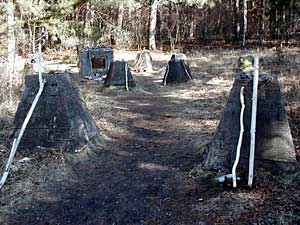 |
| Concrete blocks mark the spot where the Ojibway cemetery was on Wisconsin Point. Area Ojibway leave mementos, including tobacco, walking sticks, and dream catchers. (MPR Photo/Bob Kelleher) |
|
Superior, Wis. — Bob Miller is trying to right a wrong. Miller is founder of the Superior Indian Center, and a counselor to American Indian kids. If not for the twists of history, Wisconsin Point might have been Miller's home. His grandmother was Ojibway -- an early member of Minnesota's Fond Du Lac band. They lived in a village on Wisconsin Point.
Virtually undeveloped, the point is now a Superior, Wisconsin park. It's a wide sandy beach with grassy fields and lush forest. Miller spots a few bent old trees -- an odd hardwood stand bordering native pine and birch.
 | | ||
| |||
|  Bob Miller and daughter Bob Miller and daughter | | |
| |||
"These four willow trees that are right here. My great- grandfather planted those," Miller says. "And then my grandmother's grandmother lived on the other side of the cemetery."
Miller grew up to stories of cool Lake Superior summers. There was wild rice growing in the bay, pungent fish and fresh deer hides drying in the sun. And he heard how his people were forced off the point early in the 1900s.
Historian Ron Mershart recalls the heady days just before World War I. Duluth and Superior were growing exponentially, half a mile by water from the quiet village on Wisconsin Point.
"We know there was a community," Mershart says. "Literally, a village on the point. Technically it wasn't where the Indians were supposed to be, but homes where they always had been."
 | | ||
| |||
| Ron Mershart | | |
| |||
The Ojibway weren't supposed to be here since the treaty of 1854, which traded Ojibway land for reservations. Superior officials had plans for the point. They wanted to build an iron ore dock, a railroad and homes for the workers.
"The council had already said to the Indian village, 'That's it, you're gone. You have no legal title to this land,'" says Mershart.
The Ojibway were evicted. Even their cemetery was dug out of the sand, and the remains were moved to a mass grave in town. Oddly, it was all for no grand purpose. No industry could be anchored on the sandy point.
Mershart says Superior officals never acknowledged a mistake, or made amends.
"They had created this, what I would call, at least an ethical wrong. Maybe a moral wrong, to the Indian people who lived here," Mershart says. "And, so far as I know, there was no effort to make good, or to apologize, or to restore anything. They just decided it was park land."
 | | ||
| |||
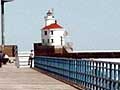
| The breakwater and lighthouse | | |
| |||
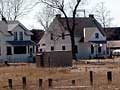
Two white houses guard the end of the point, built to service a lighthouse on a concrete breakwater. Now of little use, the federal government is giving up 18 acres, including the homes. With Bob Miller's prodding, Fond Du Lac Band officials placed a bid for Wisconsin Point, claiming priority as the former owners.
Miller says the homes could become an Ojibway cultural center. The surrounding land could be held sacred.
"What we'd like to do is return the bodies," Miller says. "If the elders agree to it, we'd like to put the bodies back where they belong, where they came from."
The bodies rest now in a mass unmarked grave, on the red clay banks of the Nemadji River in Superior. Robert "Sonny" Peacock is chairman of the Fond Du Lac Band. The band remembers well, Peacock says, the slight to their ancestors.
 | | ||
| |||
| The homes on Wisconsin Point | | |
| |||
"We know the names of many of these people that were there. And we have a history of those individuals," Peacock says. "And we've seen how that whole thing lays out within ourselves and through the oral history. That whole concept of that kind of behavior, to do that, is still there."
Peacock doesn't know if the graves can be moved. There are legal and cultural implications -- governments to talk to and agreements to be made. Tribal elders must be consulted.
Meanwhile, the mainland graves are eroding into the Nemadji River. In time, the river might carry the remains back where they came from, to the sandy banks of Wisconsin Point.
The Bureau of Indian Affairs has submitted the band's request for the land. A decision from the General Services Administration is pending.
|
News Headlines
| |
Related Subjects
|
 © 2026 | Home : Terms of Use : Your Privacy Rights


