






 |
|
|
Audio
Photos
Resources
Your Voice
|

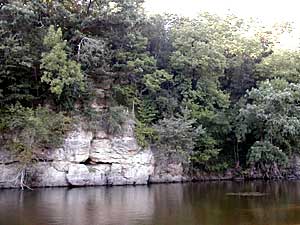 |
| These limestone bluffs are the prominent feature of a small bay along the Mississippi River -- the site of a proposed housing development that has created a bitter debate. (MPR Photo/Dan Olson) |
|
St. Paul Park, Minn. — St. Paul Park's 5,000 residents live next to the Mississippi River in the southeast corner of the Twin Cities. D.R. Horton wants to build on the edge of town.
The Arlington, Texas-based company has built more than a dozen other Twin Cities housing projects. The company wants to build up to 2,400 single family homes, condominiums, townhouses and some commercial structures in St. Paul Park and neighboring Grey Cloud Island Township over the next decade.
The development would double St. Paul Park's population.
 | | ||
| |||
|  A "friend of the bay" A "friend of the bay" | | |
| |||
The site is 600 acres in size. It's owned by Cottage Grove attorney Gordon Nesvig, who lives on the property.
Some of the land now leased to local farmers would become single family home sites. Condominiums would be built closer to the river, on land that's overgrown with trees and grass.
Nesvig says he's been interested in developing the property for years.
"The development would be an improvement because it would create some contemporary housing, some trails, some parks, open space, some access to this bay they keep talking about," Nesvig says.
The bay is a small curve of Mississippi backwater marked with limestone dolomite bluffs, topped with a scattering of old oaks and other trees and interspersed with some prairie and woodland plants.
The "they" Nesvig refers to is a group of local residents who have formed Friends of the Bay. They say growth is inevitable, but they oppose high-density development on the riverbank. Nesvig calls them radicals.
 | | ||
| |||
| Irene Jones, Friends of the Mississippi River | | |
| |||
On a boat ride tour of the bay, Friends of the Bay spokesman Harland Hiemstra, a Grey Cloud Island township resident, calls Nesvig "a local scalawag," and calls the Texas developer D.R. Horton "carpetbaggers."
"People are opposed to this in terms of the magnitude, in terms of the potential for changing the quality of life in the community, in terms of the potential traffic congestion," says Hiemstra.
The Minnesota Department of Natural Resources has entered the fray. A 30-year old state law gives the agency power to regulate riverfront development.
The DNR's 18-page letter to the city of St. Paul Park says the D.R. Horton proposal to build within 40 feet of the river's edge is too close. The state says buildings should be at least 100 feet from the edge, to avoid soil erosion and damage to the bluffs.
The federal government has little power to regulate Mississippi River bank development. However, the National Park Service administers the federally-recognized Mississippi National River and Recreation Area.
Park Service spokeswoman Kate Hanson says the St. Paul Park site is a unique piece of riverfront property in the metropolitan area.
 | | ||
| |||
| Undeveloped -- at least for now | | |
| |||
"Anybody who's seen it from the river has that sense of being far away from any kind of a city environment," says Hanson.
Construction of two five-story buildings on the river's edge would require blasting bedrock for footings.
Irene Jones, a spokeswoman for an advocacy group, The Friends of the Mississippi River, says the blasting, a proposed boat launch, and land-clearing will harm the area's natural qualities.
"There are springs and seeps that come into the little bay. It's a haven for wildlife, particularly waterfowl. There's a couple of bald eagle nests, there's some native plant communities there," says Jones.
St. Paul Park City Administrator Barry Sittlow says the D.R. Horton development poses lots of unanswered questions. But he says it's not correct to say the riverbank site, which includes a defunct stockyard and farm buildings, is a pristine natural area.
"There are areas there where junked vehicles sitting, and there's a junkyard north of the project. It's an area that needs some attention," says Sittlow. "And certainly that attention cannot be given without taking into account the river and its amenities, as well as the wildlife -- and anything else that needs to be preserved there."
The next public meeting on the proposed D.R. Horton development is Aug. 4. City officials say St. Paul Park won't issue permits for the project until questions about it's impact are aired with local residents -- and until the the DNR gets answers to its concerns.
There are more than 18 other housing or commercial projects on paper or underway along the 72-mile length of Mississippi River that winds through the Twin Cities. Officials say the activity is a reflection of the region's fast growing population and renewed interest in the river.
|
News Headlines
| |
Related Subjects
|
 © 2026 | Home : Terms of Use : Your Privacy Rights


