






 |
|
|
Audio
Photos
Resources
Your Voice
|

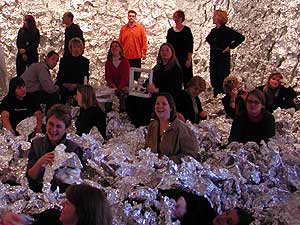 |
| A group of about 25 art teachers and students helped artist Sandy Skoglund festoon a room with aluminum foil. (MPR photo/Annie Baxter) |
|
St. Cloud, Minn. — For the artist Sandy Skoglund, some of the best art materials are things you might find lying around your pantry.
 | | ||
| |||
|  Sandy Skoglund Sandy Skoglund | | |
| |||
"I like working with aluminum foil in that the results are predictable," she says. "It's a familiar material which i've always liked the politics of that. It's something we know and use, so it goes beyond the art world.. it's not like working with bronze."
Skoglund's been doing art since since the early 60's. She's known for art installations that blur the lines between kitsch and high art, and that question the role of domestic objects and spaces. One of her most famous pieces is called Radioactive cats. It's from 1980. It shows a dowdy elderly couple sitting in a dreary grey kitchen, as dozens of electric green cats swarm around them.
In this installation at St. Cloud State, 25 art teachers and students will help cover the room in tin foil, and then participate in a performance in the space.
 | | ||
| |||
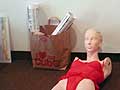
| Materials | | |
| |||
The artists bring rolls of tin foil, as well as various objects from home to use as props in the performance.
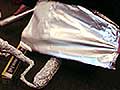
Those objects add layers of meaning to the installation. Carol Hannon-Orr brought a paint roller.
"My husband and I just finished painting our entryway and the living room and kitchen in one color," she says.
Apparently it didn't work so well
 | | ||
| |||
| The roller | | |
| |||
"Beautiful in the morning, terrible at night!" she says. "So then we repainted it again. So I had this great relationship with my paintroller.
Hannon-Orr wraps tin foil around the roller. It becomes clunky and the foil tears. It's those kinds of qualities Sandy Skoglund's after with the foil. She likes how it's cheap and kitchy, but at the same time, kind of shiny and pretty.
"I like to ask the question, 'what is beautiful?'" she says. "We would not think of it as valuable, and why can't something all the visual properties of a stereotypical sense of beautiful, why can't that be beautiful?"
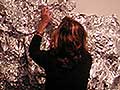
The participants set to work layering the walls of the space with squares of tin foil.
 | | ||
| |||
| Foiling the wall | | |
| |||
In a few minutes, the walls look sculpted, textured and undulating.
When it's all done, Skoglund becomes a choreographer.
"I need you to go there," she says directing her performers.
She clusters the participants in little groups around the space. They're awash in a sea of crumpled tin foil. Some sit chatting around a little foil-wrapped coffee table. Two women lie under a pile of the shiny foil, only their faces peaking out.
The "performance" aspect of the installation ends when Skoglund photographs the scene.
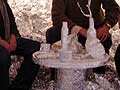 | | ||
| |||
| The foil tea | | |
| |||
And the participants break out of their poses. The installation will remain in place at the Kiehle Gallery until November 26th.
Already, people were trying to pin down what it was all about. Sandy Skoglund herself didn't give too many clues.
"To talk about what something means is, I think, really very limiting," she says "And so I think it's important to just look at it and feel it and not try to rationalize it."
For Carol Hannon Orr, the meaning was about the process.
 | | ||
| |||
| The final picture | | |
| |||
"It's just really playful. And it's unfortunate that playful sometimes with adult work can be a bad thing, when it actually can be really liberating." It's clear the installation is sparking conversations, and a few ideas. Jeffrey Herdon says he's inspired.
"It gave me some ideas for pulling a prank. Maybe tin foil someone's house or something."
In the past Sandy Skoglund has made installations with everything from grocery bags and cling wrap to broken glass. Now she's happy making art, one roll of foil at a time.
|
News Headlines
| |
Related Subjects
|
 © 2026 | Home : Terms of Use : Your Privacy Rights


