






 |
|
 |
Photos
More from MPR
Your Voice
|
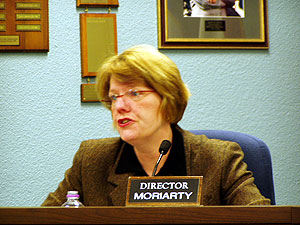 |
| Board member Colleen Moriarty says holding community meetings won't make the district's problems go away. (MPR Photo/Tim Pugmire) |
|
Minneapolis, Minn. — Minneapolis School Board members have been taking a lot of heat. District administrators triggered the flood of criticism earlier this month by proposing to close eight school programs, merge 15 schools and relocate six others. The reorganization could have left nine school buildings empty. Hundreds of parents, students and community leaders wrote letters and packed public hearings to try to stop the plan. Even Mayor R.T. Rybak urged the board to delay action.
Board member Audrey Johnson says the criticism had an impact.
"One of the things that I got out of this last few weeks is that people really did feel, they expressed a feeling of having things done to them, not with them," Johnson said. "And that to me was the most troubling part of this whole experience."
The negative feedback convinced Johnson and her school board colleagues to scrap the administration's proposal and start over. The only school that will still close next fall is Downtown Open School, which the board voted to close last year. School board members will begin developing a new plan, with lots of community involvement. A series of meetings is planned this spring to find out what district residents expect from their schools.
 | | ||
| |||
|  Ross Taylor Ross Taylor | | |
| |||
Board member Ross Taylor is optimistic.
"It seems that we do need to have this opportunity for input, for participation in the process, so that we know at the end we're not going to get something we all like, but we will get something we can all accept," Taylor said.
The Minneapolis school district continues to lose students to competing schools at an alarming rate. A enrollment drop of three thousand students is projected for this fall. Fewer students means less state funding for a district already facing a $20 million deficit.
Board member Colleen Moriarty says holding community meetings won't make the district's problems go away.
"We have less people in the school district, less young people in the school district, and we have empty classrooms," Moriarty said. "And as a board member, I can only tell you that I'm not willing to fund classrooms and not children. So, we need to be serious about the fact that as we move ahead, none of the urgency of this has diminished at all. In fact it's probably more urgent now than ever." Still, parents who've been fighting to save the schools their children attend applauded the delay. Reta Post, a Loring Community School parent, was pleased.
|
It's a chance for the community to speak their mind, a chance for problems to get fixed and a chance for things to happen.
- Reta Post, parent of a Loring student | |
"It's a good decision," Post said. "It's a chance for the community to speak their mind, a chance for problems to get fixed and a chance for things to happen."
Post says she's willing to get involved in the coming months to help the school board develop a new strategy.
John Sheehy, a parent who's been organizing opposition to the school closings, says the board made a wise decision. He says he'll continue his efforts beyond Minneapolis to pressure state lawmakers to increase funding for public education.
"I think it's crazy to be talking about stadiums and building stadiums when you're closing neighborhood schools and inadequately funding schools," Sheehy said. "I don't think the taxpayers are going to accept that."
The Minneapolis school board is planning to hold a series of public meetings in April and May to discuss solutions for the district's enrollment and financial issues. The board's goal is to have its new plan ready by October 1. If any schools are closed or realigned, it would take effect for fall 2005.
|
News Headlines
| |
Related Subjects
|
 © 2026 | Home : Terms of Use : Your Privacy Rights


