






 |
|
 |
Audio
Photos
Your Voice
|
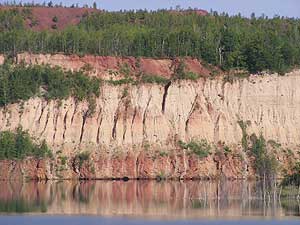 |
| The walls rise almost straight up, nearly 200 feet above the Canisteo pit. The retired mine pit looks like something out of the American Southwest. But it's eroding, and flooding -- putting nearby towns at risk. (MPR Photo/Bob Kelleher) |
|
Bovey, Minn. — We're walking across a steel railroad bridge. It's rust red and covered with little iron marbles -- taconite pellets spilled from countless trains. On the left is a small town. On the right is what appears to be a huge lake. Rutted red and tan walls of the Canisteo pit rise straight up -- maybe 200 feet above the turquoise water.
Underneath all that water are the iron mines where Dave Lotti used to work.
 | | ||
| |||
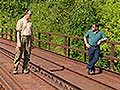
|  The railroad bridge The railroad bridge | | |
| |||
"My family worked here," Lotti says. "Both my brothers and my father worked here. I moved shovels and drove truck here -- things like that. So I've got a good idea what this looked like when it was dry."
Now it's filled mostly with rainwater. The pit has no outlet. When the mines were open, operators pumped them dry. But that began changing 30 years ago.
"These started closing down in the late '70s, into the early '80s," says Lotti. "September of 1986, that's when the pumping ceased, and it began to fill up. It's been filling ever since. At various rates, as Bob can tell you," Lotti says, pointing to his companion, Bob Liebfried, a hydrologist with the state Department of Natural Resources.
"When they shut the pumps off and quit mining, of course, water started to accumulate, very rapidly," Liebfried says.
At first, he says, it would rise some 70 feet a year, until the water spread out across the wider upper pit.
 | | ||
| |||
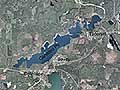
| Aerial view, Canisteo Pit | | |
| |||
"It's been rising since we've studied it intensely," Liebfried says. "Since 1994, it's risen at a rate of five (feet) to about a foot and a half a year. So, it's slowed down a little bit. Last couple of years it slowed down, really because of the lack of precipitation."
Eventually, he says, the pit will flood, right into the towns of Bovey and Coleraine, unless the water can be drained off.
"If we were just to allow it to rise, without us controlling it, it would naturally flow right underneath these tracks," Liebfried says. "We're seeing problems already with the pit, at the level it is right now."
Erosion is eating the pit walls, taking trees, fences and roads with it.
"It seems maybe we've got some time to wait to solve the problem," says Liebfried. "But we really don't."
Dave Lotti says it's not clear how much time there is.
"We don't really know," Lotti says. "We're hoping that we're out at least five years from anything really drastic, but this erosion thing is going on 24/7."
Bob Berghammer, a member of the Bovey City Council, is less optimistic.
 | | ||
| |||
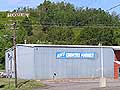
| Bob's Country Market | | |
| |||
"Well, this five or 10 year stuff is way wrong," says Berghammer.
Berghammer owns Bob's Country Market, just on the town side of the railroad grade.
"I think we have, two years at best," Berghammer says. "The railroad quit using the tracks here Feb. 22. They're only 25 feet from the edge of pit. This could give out any time, you know. Two hours from now. Two months from now."
The railroad grade is all that's between Bob's store and a lot of water.
"I would say right now, we're probably 15 feet underneath the water," says Berghammer. "And if it was to let go, we would lose, I would bet you, at least 25 to 30 percent of this town."
Other official predictions aren't so dire. Planning and Zoning Director Mike Bibich says the water would likely come as a stream instead of a torrent.
The city doesn't have a disaster plan for a flood. But Bob Berghammer worries that lives could be lost if the grade broke without warning. There are plans to drain the water, but plans don't come cheap.
"They're making some progress finally, but we need some funding to fund the project," says Berghammer.
The Legislature was ready to bond $3 million to evaluate drainage plans. But the Legislature never finished its work. And federal money is tight because of the war.
"Government's slow," says Berghammer. "And water is rising."
Area legislators will try again next year. Maybe the water will stay put until then.
|
News Headlines
| |
Related Subjects
|
 © 2026 | Home : Terms of Use : Your Privacy Rights


