
Site Navigation



|
Audio
Photos
More from MPR
|

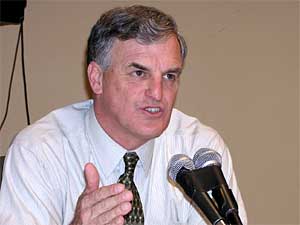 |
| Minneapolis mayoral challenger Peter McLaughlin is running a series of television ads in the last days before the Nov. 8 election. (MPR Photo/Tom Scheck) |
Minneapolis, Minn. — Peter McLaughlin's campaign spent $50,000 on a TV ad that will run on two Twin Cities stations. The commercial features McLaughlin at a light rail stop, talking about his role in getting the trains running.
"Against all odds, we brought together state, federal and county resources to build the Hiawatha LRT," McLaughlin said in the ad. "Now it's creating jobs, expanding the tax base and benefiting the environment."
McLaughlin says he took the unusual move of buying the ads for a mayoral race because he wants to reach voters who aren't sure who they'll vote for next Tuesday. A recent University of Minnesota poll showed McLaughlin trailing R.T. Rybak by 9 percentage points. But the survey also found a large 20 percent of respondents were undecided.
"This is a TV world that we're in right now," McLaughlin said. "We made a decision getting on television was important so people could hear from me and see me. A mayor has a lot of access to media. He gets a lot of media exposure. As a county commissioner, I don't get as much access to the media and I frankly don't devote as much energy to getting media attention."
McLaughlin's ad will air 165 times between now and Election Day. He's also tapping his personal bank account for his campaign.
McLaughlin lent $45,000 to the campaign between Jan. 1 and Oct. 25, 2005. McLaughlin says he has lent the campaign even more money since the most recent reporting period closed, but he wouldn't say how much.
"If you want to buy TV you've got to plunk your money down, so I did provide an additional loan to the campaign," McLaughlin said.
In total, McLaughlin's campaign raised $293,000 between Jan. 1 and Oct. 25. He has spent $277,000 during that time.
Rybak has raised and spent more, but has less in the bank. The mayor raised $329,000 and spent $318,000. Rybak lent his campaign $10,000. He says he doesn't think McLaughlin's ad buy will have an impact on the race.
"If somebody wants to run some television, that's fine," Rybak said. "I'm going to stick to my game planm which is to look every voter in the eye and ask for their vote. I'll do what I did the first time and this time, and say I'm a grass roots mayor who's going to go door to door and ask the people to give me four more years to finish the job."
Rybak says he's spending the bulk of his money on campaign literature and other get-out-the-vote efforts. He also emphasizes that his donations are not coming from anyone who's doing business with the city.
"Unlike my opponent, I'll be able to go into office without being tied to special interests who want to keep pensions from being reformed, lobbyists with active projects before the city, developments up there," Rybak said. "I'll walk in clean, and I think it will give me a freer hand. That made me a better mayor the last four years and it will make me a better mayor the next four."
McLaughlin says he is taking money from groups that do business with the city. But says he can also say no to any campaign contributor if the project is a bad deal for the city.
While the two spent part of the day sparring over campaign cash, they also attended a formal debate. The Children's Advocacy Network sponsored the debate at the Minneapolis Urban League in north Minneapolis.
Most of the questions focused on federal and state issues that a mayor has little role in. But there were some questions about public safety, after-school programs and city services.
Rybak says his plan to add more police officers will help reduce gang violence. But he also says anyone buying drugs in the community is a part of the problem.
"Any person who buys marijuana in this community is putting money into the hands of gangs," Rybak said. "You buy a joint, you're putting a bullet in the head of a kid in north Minneapolis."
McLaughlin stuck to his main campaign theme that the city has become less safe since Rybak took office. He says crime-ridden neighborhoods won't improve unless there's a basic level of public safety.
"You can wring your hands about wanting more jobs or more participation in park programs," McLaughlin said. "But if there's a high level of violent crime in a neighborhood, the investment is not going to happen in that neighborhood."
The two candidates say they'll spend the rest of the week door-knocking and working on other efforts to get voters to the polls next Tuesday.
|
|